The annual Regional Banknote and ID Document of the Year Awards, a highlight of the High Security Printing™ EMEA conference, took place in Rabat, Morocco on 10 February 2026. The event brought together government ministries, national identity authorities and technology providers from across Europe, the Middle East and Africa to recognise outstanding achievements in design, security and technology innovation in identity documents.
With awards spanning both physical and digital credentials, this year’s winners illustrate how issuers in the EMEA region are modernising their document and identity systems while maintaining high levels of interoperability and fraud resistance.
The Best New National eID Card award was presented to the Estonian Police and Border Guard Board for Estonia’s new-generation national ID card, issued from November 2025.
The card combines an upgraded secure physical credential with the country’s mature eID ecosystem that underpins ‘eEstonia’.
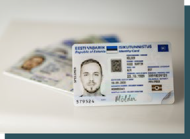
Its nature-inspired design aligns with the wider Estonian document family, using a consistent colour palette, typography and security motifs across passports, residence permits and driving licences. A diffractive surface pattern mimics the movement and shimmer of water, while a new-generation DOVID shows a boulder emerging from water, referencing Estonia’s abundance of glacial boulders. The national bird, the barn swallow, appears through a suite of tactile and optically variable features, providing intuitive first-line checks.
As a world first, the card incorporates Thales Gemalto RevealPlus, which combines a window with a secondary portrait, a decoder lens and hidden data in the portrait.
When tilted, animated rolling text and different data become visible depending on the viewing angle, creating a distinctive and highly secure dynamic effect.
Thales Gemalto True Vision adds an additional control: under UV light, a cornflower appears on the reverse of the card in its natural colours.
The translucent polycarbonate body allows the contactless antenna to be seen within the inner layers, reinforcing both security and perceived high-tech quality.
The card embeds an advanced chip solution usable in both contact and contactless modes and remains a cornerstone of secure access to Estonia’s public and private digital services.
The Best New Passport award was presented to the Principality of Liechtenstein for its new-generation, fully redesigned passport family, introduced from 3 February 2026.
The series standardises all passport types and travel documents on a single technical and design platform.
The document incorporates a polycarbonate datapage with a fullcolour personalised portrait, which is duplicated on the first paper page, adding a secondary verification point using a different personalisation technology and substrate.
Security printing has been comprehensively upgraded across the booklet. Each visa page carries individual artwork combined with fine-line guilloches and other security line structures, aligned with the thematic representation of Liechtenstein’s 11 municipalities. The front and back endpapers integrate detailed cartographic and informational content, which also serves as a security layer through precise, small-format printing.
Under UV illumination, a multicolour fluorescent image of Vaduz Castle appears on the datapage, providing an easily recognisable, high-resolution landmark motif. Additional UV features, including contour lines and street layouts on the inside pages, create complex yet meaningful patterns that are difficult to simulate while remaining intuitive to inspect.
On the issuance side, biometric enrolment is now fully live-capture. Applicants no longer submit photos or paper forms; instead, image and data capture are performed on-site. The upgraded workflow enables immediate passport issuance following application, combining a modernised security architecture with highly efficient, technology-supported personalisation and delivery.
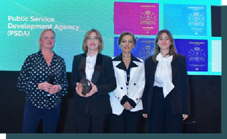
The Best New Series award was presented to the government of Georgia for its harmonised suite of ePassports and eID cards built on a single design and security platform. Developed by Veridos in close collaboration with Georgian designer Nino (Nitta) Gongadze and the Public Service Development Agency under the Ministry of Justice, the series unifies six passport types and four identity cards with aligned materials, features and visuals.
The core design concept, ‘A Journey Through History, Secured by Design’, integrates national geography, culture and historical heritage directly into the security architecture. In the ePassport, each double-page spread is dedicated to a specific region of Georgia, combining objects, landscapes and symbols with cartographic elements. These map components anchor every motif in a precise geographic context and provide structured fine-line artwork for security printing.
Under UV light, the visible story continues as a hidden layer. Native flora and fauna, historical artefacts and additional symbolic elements appear in fluorescence, creating a second, coherent narrative that is both visually rich and technically complex.
The transition between daylight and UV designs is continuous across the booklet, supporting intuitive inspection while significantly increasing the effort required for simulation.
The security substrate is a custom paper with a primary watermark of the Georgian coat of arms and a security thread integrating the national flag and historical inscriptions. Highlight watermarks with page numbers appear on every page, while multi-coloured intaglio printing, optically variable inks and embossed structures provide strong tactile and optical first-line controls. Key inner pages incorporate national cartography and the text of the anthem, both further developed in UV to form densely layered security backgrounds.
The polycarbonate datapage is fully integrated into the graphic concept and incorporates a transparent window, holographic elements, optically variable pigments, micro-lettering and rainbow printing, together with complex embossing.
A transparent stripe deliberately reveals the antenna as part of the design, with a dedicated UV brilliance effect that enables rapid verification of the electronic inlay and its position.
The project encompasses a 10-year rollout of multi-million secure identity documents, including complete system architecture and three personalisation sites, all implemented within one year of contract award in late 2024.
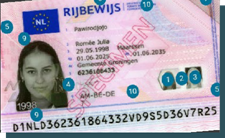
The Netherlands Vehicle Authority (RDW) was awarded Best New Driving Licence for its new model licence, which went into production from June 2025, updating the card’s visual design and strengthening its authenticity features while keeping the familiar ID-1 format 1.
Described in public communications as a ‘hidden masterpiece’, the licence is designed to reveal its value through straightforward checks – look, tilt, feel and UV – while also raising the technical barrier for counterfeiters. RDW notes that ‘not everything is visible to the naked eye’ and highlights that UV inspection reveals concealed illustrations, including motifs such as a road network and traffic lights.
At the heart of the new model is a multi-technology security architecture comprising 11 authentication features.
These include a Sealys® clear window combined with multiple laser image effects, a positive/negative image element, a diffractive optically variable image device overlay, visible elements of the chip antenna, microtext, and a secure background design.
The licence continues to include a contactless chip that supports online authentication, aligning the physical credential with digital service access where higher assurance is required. The production contract for the new model was awarded to Thales, which also produces Dutch vehicle registration certificates.
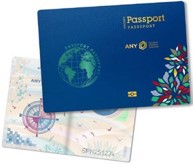
The Best New House Passport award was presented to ANY Security Printing for its Collaborative Sample Passport, a marketing ePassport produced with SICPA, IQ Structures, BP Security, Hueck Folien, ANY SecLab and other partners.
Conceived as ‘a journey through security, art and collaboration’, the booklet demonstrates how an integrated security architecture can be built around a coherent design narrative.
The passport combines a patentprotected, full-colour cover with customised UV graphics and bespoke security paper integrating a multitone watermark, embedded security thread and in-house-developed UV bi-fluorescent shiny dot additives.
The inner covers and visa pages use intaglio, offset and screen printing with IR-transparent and IR-absorbing inks, negative microtext, latent images, UV rainbow printing and up-converting luminescent inks. Penta-fluorescent offset inks provide five distinct optical responses across UV and IR bands.
A fully ICAO-compliant polycarbonate datapage features SICPA SPARK® optical security, colour-shift elements, hidden image, laminated tactile features and DualGlow™ clear-window fluorescence.
Security is further enhanced by IQ Structures’ full-surface nanoDOVID® IQ proID construction, delivering large transparent and metallic diffractive areas that protect all personalised data and resist delamination.
The serial numbering employs multi-level laser perforation through the booklet, with variable character size, hole pattern and embedded variation in the dot structure.
On the observation page, AURORA, developed by ANY’s Innovation Hub with BOSCH’s Origify team, links a surface ‘fingerprint’ to a multi-layer secure QR code for smartphone verification and track and trace. Augmented reality markers provide an additional app-based authentication and engagement channel, illustrating physical–digital convergence in next-generation passport design.
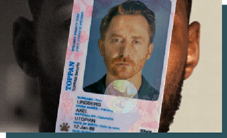
The Best New Technology award was presented to TOPPAN Security for CHROMA, a pure colour laser technology that creates lifelike, high-definition images directly inside polycarbonate structures, without any surface printing or additional inks.
The system uses a single laser source to address three colour channels – cyan, magenta and yellow – in a CHROMA reactive polycarbonate layer integrated during lamination. Operating on a subtractive colour model with finely tuned laser parameters, it can reproduce up to 16.7 million colours.
This subsurface construction is highly resistant to abrasion, tampering and environmental stress; attempts to peel, lift or replace the portrait will irreversibly damage the polycarbonate body. A characteristic micro-line structure visible under 15× magnification provides an additional forensic feature. The technology complies with ICAO portrait standards and maintains standard polycarbonate document thickness.
1 - https://www.rdw.nl/het-rijbewijs/over-het-rijbewijs/rijbewijsmodel-2025